

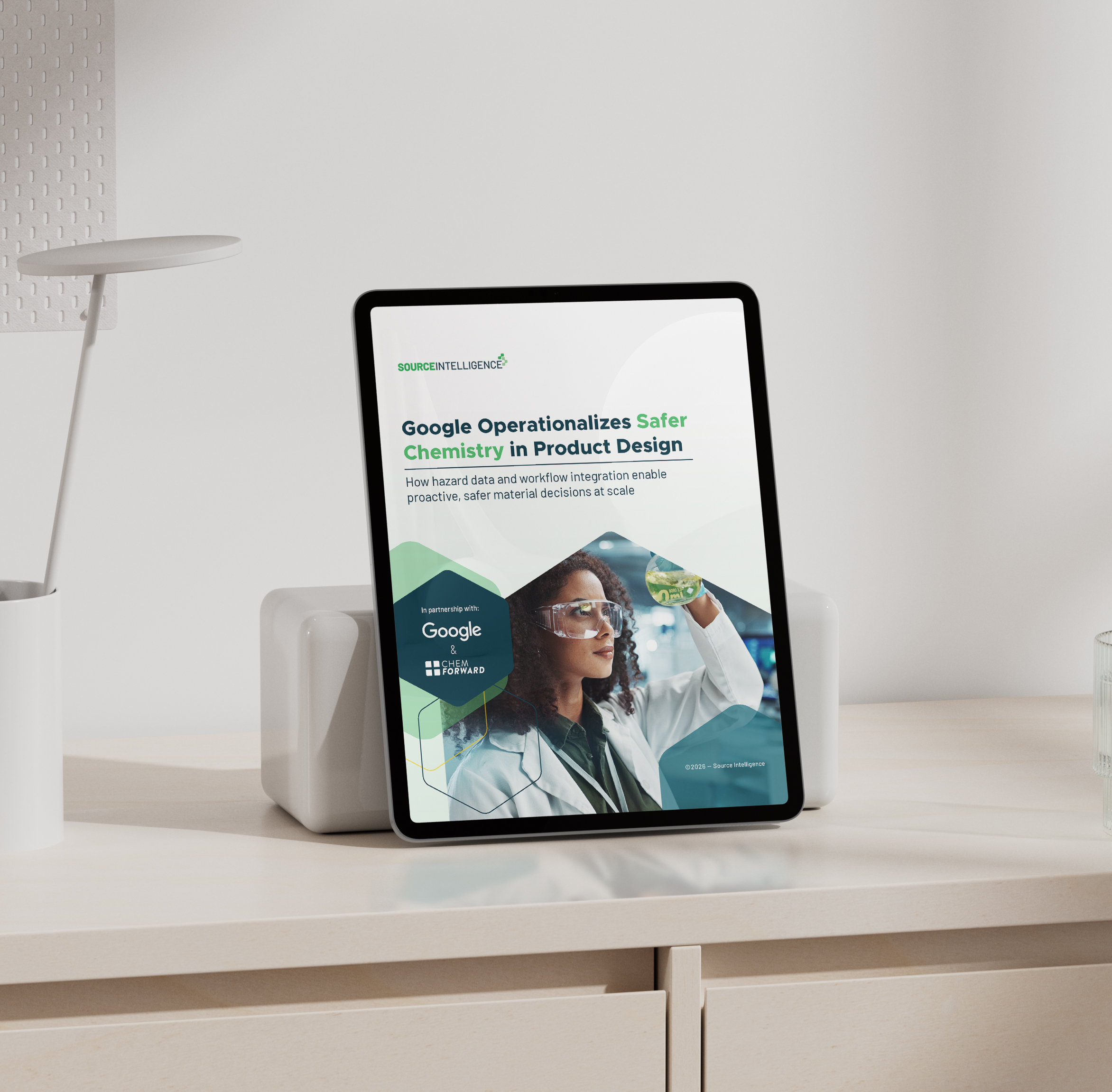
Google Product Compliance Case Study

See How Google Scales Chemical Risk Management With Safer Chemistry

Google partnered with Source Intelligence and ChemFORWARD to embed proactive compliance into chemical risk management at scale.

See how Source Intelligence connects hazard data to structured product data at scale

Learn how ChemFORWARD’s chemical hazard assessment integrates directly into product workflows

Discover how Google evaluated 15 candidate solvents to select a lower-hazard option for Pixel

Get the Guide

The challenge of safer chemistry at scale

Traditional chemical compliance wasn’t built for this scale.

More than 230 global regulations govern chemical use, and most compliance programs still rely on restricted substances lists that respond only after requirements are finalized. That leaves gaps when substances lack complete hazard characterization, and limits how early teams can act.

01

Chemical complexity keeps growing

Hundreds of thousands of substances remain active in commerce, and global supply chains make it harder to keep pace.

02

Reactive screening leaves gaps

Restricted substances lists respond to regulations after they’re finalized, missing substances that lack complete chemical hazard assessment data.

03

Intent alone doesn’t scale

Many organizations set safer chemistry goals but lack the product compliance software to make hazard-based decisions actionable.

Inside the case study

How Google partnered with Source Intelligence and ChemFORWARD to build a replicable model for chemical risk management.

This case study breaks down how Google embedded proactive compliance into existing product workflows, and how your organization can apply the same model.

Insight #1

See how hazard-based decisions move upstream

Understand how Google’s Restricted Substances Specification builds chemical hazard assessment into materials evaluation, earlier in development.

‍

Insight #2

Learn how C-Map connects hazard science to product data

Explore how Source Intelligence’s product compliance software structures chemical and material data across nested product hierarchies.

‍

Insight #3

Explore the Pixel solvent selection process

See how Google evaluated 15 candidate solvents side by side and selected a lower-hazard option without sacrificing performance.

‍

Insight #4

Understand what this means for governance and investors

Learn how automated screening and structured disclosures support ESG credibility and audit-ready documentation.

Product Design & Engineering Teams

Compliance & Regulatory Teams

Sustainability & ESG Leaders

Who should read it

Built for teams managing chemical risk across complex supply chains.

From product design and engineering teams to compliance and sustainability leaders, this case study helps organizations move from reactive screening to proactive, hazard-based decision-making.

Build a replicable model for safer chemistry

Explore how proactive compliance works at scale.

Chemical risk management doesn’t have to stay reactive. Download the case study to see how Google embedded chemical hazard assessment into its product workflows, and what it means for your own compliance program.